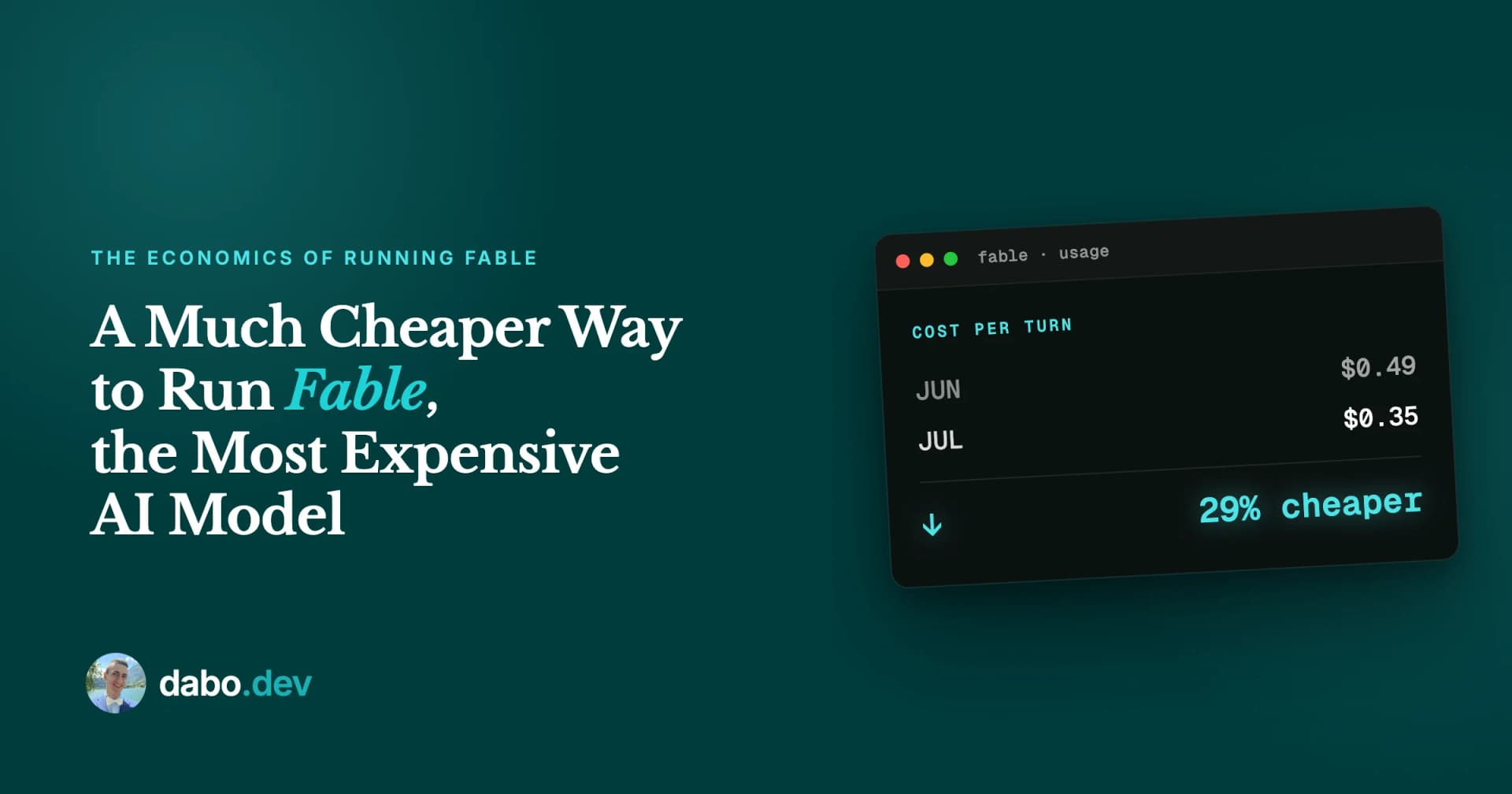
Fable is the best AI model I've used, and the most expensive by a wide margin. It runs $10 per million tokens in, $50 out, double Opus. I got it free on Max for two short windows, and I price every session at the API rate even when it's free, so I know what each one would have cost. The two windows weren't the same work, so the honest way to compare them is cost per turn. That fell from about $0.49 to $0.35 between June and July, roughly 29% cheaper. Same model, cheaper turns. I did it by giving Fable less to do.
That matters now because the free ride is ending. Last time I wrote about Fable, Anthropic had just put it free on the Claude Max plan, the US government switched it off three days in on national-security grounds, and I ended on "it's gone right now, with no firm date for its return." It came back: export controls lifted June 30, and Fable's been included on Max again since July 1, capped at half my weekly usage. Anthropic keeps extending the window a few days at a time, free through July 12 as I write this, and says it moves to usage-based pricing when it ends. So the second window was a chance to answer a question that will cost real money once the free ride ends: how do you get Fable's judgment without paying Fable's rate for everything it touches?
Here is what the two windows came to.
June: 3,302 turns with Fable, about $1,605 of equivalent compute. That works out to $0.49 a turn. July: 3,170 turns, about $1,097. That's $0.35 a turn, 29% cheaper.
The work wasn't the same across the two windows, so the totals aren't the comparison. The per-turn cost is, and that drop came from one change I made between the windows.
The rule: plan and judge, don't type
I gave Fable a job description. It plans the work, decides the approach, and reviews the result. It does not do the grunt work. The actual labor, reading the files, writing the code, running the checks, doing online research, goes to Opus and Sonnet running underneath it as sub-agents. Fable directs, the cheaper models execute.
Why that saves money isn't obvious until you see where an agent's bill actually goes. Every turn, an agent re-sends the story so far, and that context gets cached so the model isn't re-reading it cold each time. The cache is most of the cost. In June, with Fable doing everything, it carried about 9,800 tokens of fresh context per turn. In July, with the heavy reading and writing pushed down to sub-agents, half that. On a model that charges $50 a million to write and a premium to cache, halving the load Fable carries is most of the bill.
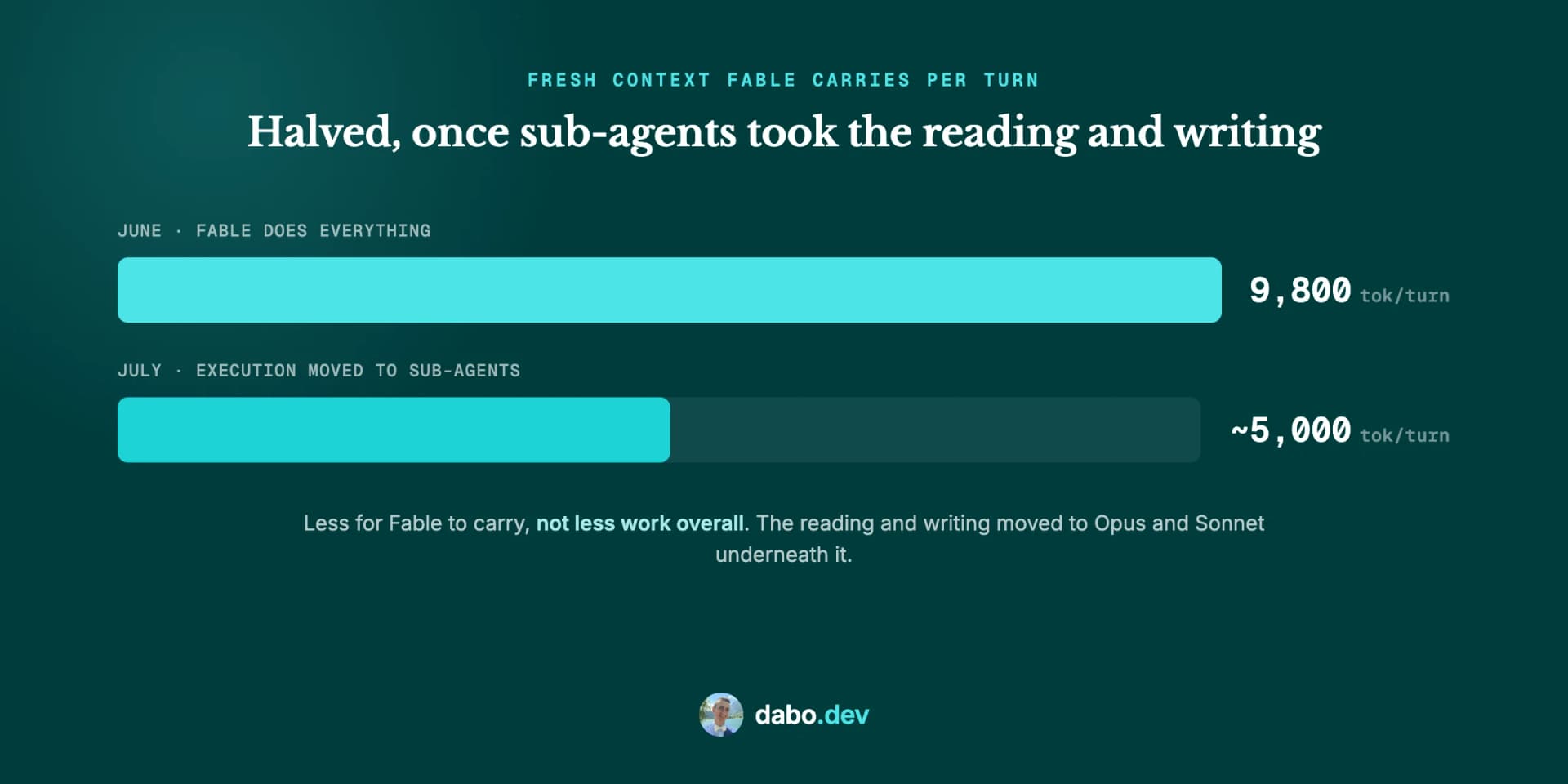
68% of the per-turn drop came from that one line on the invoice. It's the same split I guessed at the end of the last post: plan with Fable, build with Opus, bring Fable back to polish. Back then it was a hunch. Now I've measured it.
Most of the saving is delegation, not efficiency
Here is the honest part. It's not Fable getting more efficient. It's me moving work off Fable and onto cheaper models. Fable's slice of the bill shrank because Opus and Sonnet now do the parts that used to run on it, not because the total work got smaller. Only one piece of the drop, the 13% less context Fable re-reads each turn, is Fable doing the same job for less. The rest is routing. My Fable cost per turn fell by 29%. The all-in cost across all three models didn't come close.
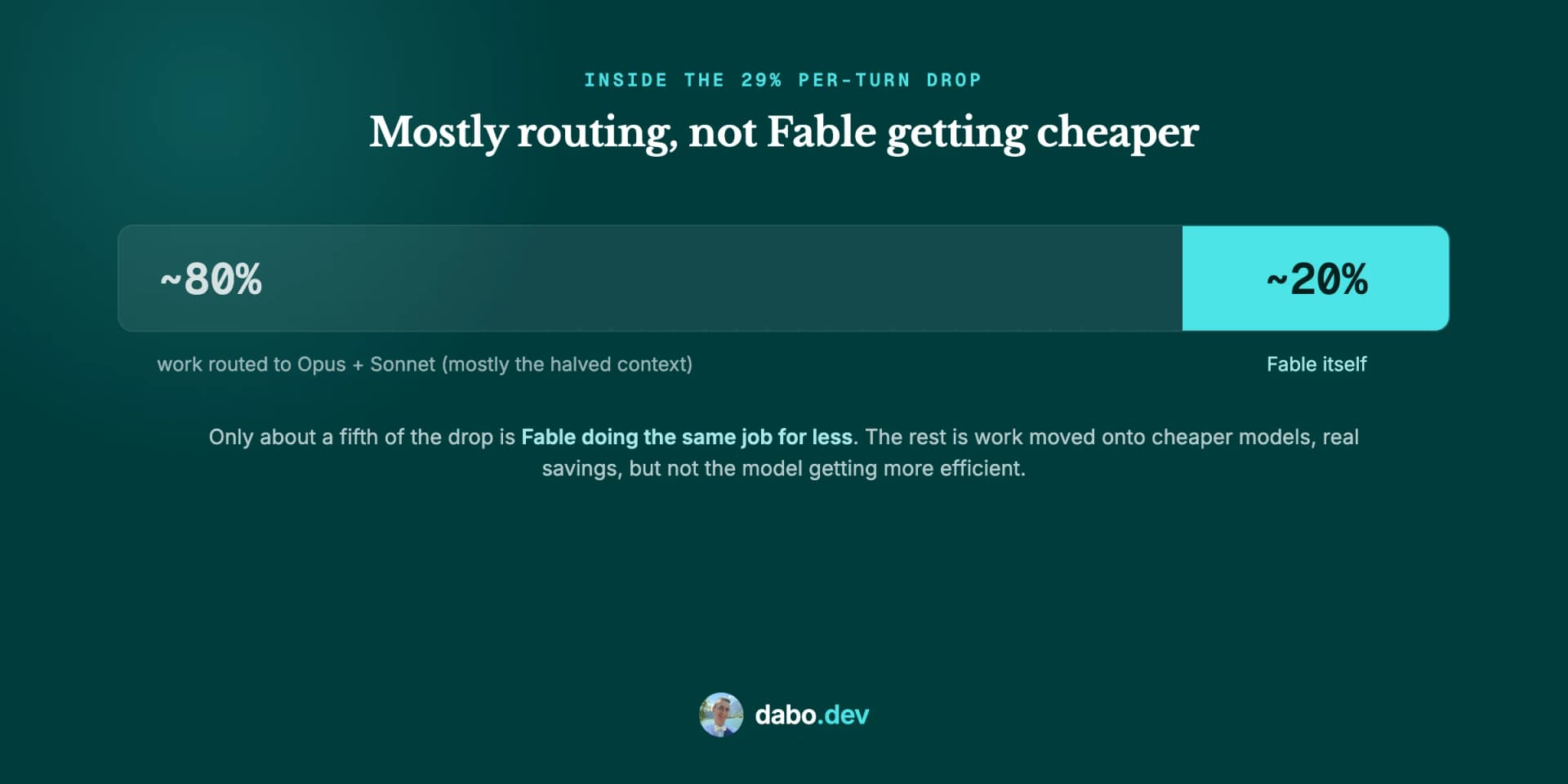
This didn't cost me anything while Fable was free. Once it's usage-based, it will.
What it costs on usage-based pricing
When Fable comes off the included plan, it won't vanish. It moves to usage credits: $10 in and $50 out per million tokens, stacked on top of the subscription I already pay. Opus and Sonnet stay on the plan, and only Fable overflows to usage-based pricing. Anthropic says it's temporary, that Fable returns to plans once they have the capacity, no date attached. This time it isn't the government, just not enough compute to keep the best model included on a flat plan.
Point Fable at everything and its turns price around $0.49 each. Point it only at the parts it's best at and they land near $0.35. Across a run the size of mine, that's the gap between roughly $1,600 and $1,100. Free, that gap bought me nothing but speed. On usage-based pricing, it's a third off the bill.
So here is what I run on usage-based pricing: let Fable plan and decide, hand the typing to Opus at half the price, and bring Fable back for the design and the final pass, where it's genuinely ahead. It's the same setup that made my July turns 29% cheaper while Fable was still free. I didn't need it to be cheap then. When the free ride ends, I'm ready.